Showing posts with label Birds. Show all posts

Friday, 19 June 2015

DIY and Newbuild Homes - Urban Wildlife's worst nightmare

Urban wildlife has taken a bit of a bashing in recent years. One of my favourite species is the House Sparrow, in the mid 20th century every street in every town in Britain would have a chirpy little flock of these fellas. They are incredibly social birds and have a great character, like little Jack Russell's with wings and beaks!

A House Sparrow on the roof of my garage in Penge, South East London

But since 1967 their numbers have declined by 67%. Ornithologists from the BTO have suggested a couple of reasons for this. Firstly lots of gardens in towns have been either decked, paved, graveled or had a whopping great big trampoline put in them, lawns are obsessively mown and weeds removed with impunity. This removes both habitat for nesting and also a source of seeds and insects. Secondly modern homes don't have the little nooks and crannies that older homes have in abundance, again another important source of nesting habitat for the House Sparrow. The combination of both of these factors is what has silenced that happy little 'churp' from our streets. I am fortunate; I live in the Alexandra Cottages in Penge. These are a series of terraced social housing streets constructed as a bit of a social experiment in the early 19th Century, There are tons of little hidy holes for the sparrows to flit about in, trees and a mature hedge. Consequently there is a relatively large population here.

However conservation of species, particularly in urban settings, is about doing your little bit to help. If we all did so then many of our species (the Hedgehog anyone?) would be in much better shape than they currently are. With that in mind this Spring and Summer I have engaged in a little rewilding project of my own! Braving the passive aggressive distaste of the Alexandra residents association I have left my lawn unmown and my borders relatively weedy. Immediately I noticed more bees, bugs and ants in the garden. I have had a feeder up for the birds for a while but I now also see them feeding in my 'meadow'. A Lapwing will land soon, just you see.

My wildflower meadow, just one of the mosaic of habitats present in the Penge Nature Reserve

There is a little ecosystem in my yard and front garden which is really thriving. The House Sparrows feed from my feeder and lawn, Wood Pigeons and Collared Doves mop up after them and Blue Tits and Goldfinches, although not brash enough to visit my feeder which is very close to the back door, flit among the trees and border picking off insects. I have Blackbirds on my roof and in my garden and even a little mouse (that Inna and I have dubbed Charlie) picks up the husks and bits the birds don't want.  One of the most spectacular sights are the Swifts, feeding hundreds of feet above the houses in long graceful flights. These are the Spitfires of the bird world and are another species that is struggling due to the modernisation of our homes. Although I have no way of knowing it I like to think that some of the insects they are feeding on up there were hatched in my weedy border and long grass!

Penge national nature reserve, free to visit but please leave a donation.


Thursday, 28 May 2015

London Wetland Centre - 28th May

Today I visited the London Wetland Centre for the first time, a nature reserve managed by the Wildfowl and Wetlands trust. It is a beautiful spot, a real oasis in the city, there were a lot of families out enjoying the sunshine. I arrived and walked the 'West route' over to the 'Wildside' hide.

Just below the hide was a Lapwing which I watched for a good hour, it was feeding in a shallow pool and chasing away starlings from a nearby group that came near. At one point a Grey Heron landed close and the scrappy little Lapwing chased that away as well! It wasn't until I watched it for 15 minutes that I realised that there were 3 chicks feeding nearby, it was a very protective parent. I got a snap of it but without a decent camera I am afraid none of my photos are very good. The current UK population is 140'000 pairs. Unfortunately they are on the RSPB redlist with a 50% reduction in their population since 1985 mainly due to habitat loss through changing farming practices. I know from Dad that some have nested in the fens near Thorney in recent years, the move to planting Winter cereals has meant that often the cover is too dense for them to nest in the Spring.

Lapwing feeding, the chicks were too hidden to get a clear photo

Nearby there were also a pair of Great Crested Grebe (5'300 adults) and a Common Tern (12'00 pairs) surrounded by Tufted Ducks. 

A pair of Great Crested Grebe (they were quite far away...)

Below is a summary of all the species and numbers I was able to spot.


Tuesday, 19 May 2015

A productive day...

I was pretty happy when I saw the Goldcrest this morning but I can add two more species to my productive day; while walking to invigilate an exam in the gym I saw a Green Woodpecker on the lawn surrounding the duck pond. I think it was a male as its 'moustache' had a red centre.

Then on the walk home I took the top path through the trees as you enter Crystal Palace Park. I'd seen a great tit feeding some juveniles here last week and it is often a good spot to hear a Song Thrush. I was stopped by a melodic warble and took a few steps off the path. Peering into the foliage I saw something new to me, a quick look on my RSPB app confirmed it was a Blackcap. Again this was a male, with a black, rather than terracotta cap. The Blackcap is a Summer visitor although more and more are wintering in the UK as well. I find it hard to differentiate the songs of warblers so I was pleased to actually sight him and get a confirmed identification.

Having listened to both the Robin and Blackcap at home I'd say that the Blackcap is deeper in its song, somewhere between a Robin and a Blackbird but with less trilling than the latter.

What a day then! Britain's smallest bird, our largest (and I think prettiest) woodpecker and a new warbler.


Britain's smallest bird

I had a notable sighting on my walk in to work this morning. Whilst coming up Crystal Palace Park Road a tiny shape flew in front of me and stopped on a branch perhaps 3 feet away. I tried to get a photo but it flew off before I could focus on it. It was not a bird I had seen in the flesh before but one that I instantly recognised.

The Goldcrest is Britain's smallest bird species, the one I saw couldn't have been much bigger than 7cm. They have a very distinctive yellow cap on their heads which shows more orange when the male is displaying. Their little beaks are perfect for picking insects, their main food, out of pine needles. Found predominantly in coniferous woodland they also inhabit mature gardens and mixed woods. They are relatively common (650-700 thousand pairs) and numbers have increased. Milder winters help their population a lot.

Since seeing it I have listened to it's song in the hope that I will be able to pick it out on my walk in. It is a thin rising 'tee-lee-dee, tee-lee-dee, tee-lee-dee' which I reckon I could identify if I heard in the wild now. Its call is a very delicate 'seeeee'. A really special moment that has put me in a good mood all day.

The Goldcrest - Britain's smallest bird :-)

Friday, 8 May 2015

Dulwich Wood - 8th May

Ask my family to describe my personality in 5 words and one they might come up with is obsessive. When I get something into my head it is often all I can think about. At the moment that's birdsong! I am hoping for a career in ecology once I have completed my Master's degree and species identification is an important field skill to have, combine that with my obsessive nature and you get the current state of play, annoying Inna with recordings of bird song and stopping to I.D. every call I hear.

I'm lucky enough to have free Friday afternoons on my current timetable and spent some time this afternoon in Dulwich Wood. The woodland is privately owned by the Dulwich estate and is what remains of a once large mixed woodland covering much of what is now South London. It is an amazing place, you can completely forget you are in the city once you step inside.

Dulwich Wood - prettier that the entrance suggests

I found myself a quiet corner and spent 30 minutes listening and looking. This is a breakdown of what I was able to I.D. (click on the links to hear their calls)

Chiffchaff - once you have learned this little fella's call it is instantly recognisable. It is a series of little 'zips' and 'zaps' in almost perfect 1-2-3 time. You could waltz to it! They look VERY similar to Willow Warblers and you can only really differentiate them by their call.

Blue tit - one of my favourites, a loud 'meep' followed by rapid little couplets for about 3 seconds. Today's was a bit shy and was cutting his song short, not sure what that means in terms of behaviour. Their cackling call is also very distinct.

Great tit - imagine a squeeky bicycle pump and you are not far off. They add happy little backing vocals to the noisier Robins and Blackbirds.

Chaffinch - another beauty, rapidly descending trills finishing with a flourish.

Blackbird - a melodic warble, again with a flourish at the end. One of the most common songs you will hear.

Ring necked parakeet - not pretty, in fact a bloody racket. Nice to look at though...

Robin - if the Chiffchaff is a stickler for keeping in time the Robin is more free-form jazz. Melodic and lyrical, once you've got it pegged it is one you'll hear a lot of. Their little 'tic-tic-tic' call is very reptilian.

Song Thrush - masters of improvisation. Individuals have up to '100' different phrases and will repeat them in little groups of 3-5. The song carries a long way. Another favourite.

Wood pigeon - the baritone section!

Jay - you'll hear him more than you see him. A favourite of mine, just not to listen to.

Add to this various other subtle calls and songs which I am not yet talented enough to identify and you have got a diverse little spot. The Greater London National Park is a movement aiming to make one of the most bio diverse Urban environments in the UK a recognised national park, not a bad idea if you ask me.

Dulwich Wood Panorama - one of my favourite spots in London


Wednesday, 6 May 2015

Coots and Geese in Crystal Palace Park

While my wife and I miss living in Balham, one of the best things about living in Penge (apart from the Pawleyne Arms) is the proximity to Crystal Palace Park. It forms the core of most of my running routes and is a haven of green space and wildlife.

Regular sights that make me smile are:
  • Mallards
  • Moorhens
  • Tufted ducks
  • Great Crested Grebe
  • Ring necked parakeets (noisy buggers)
  • Jays - my favourite
  • Sparrows
  • Starlings
  • Canada geese
  • Great Tits and Blue Tits
  • Robins
  • Grey Squirrels
  • Rats (don't make me smile so much but I don't begrudge them their place!)
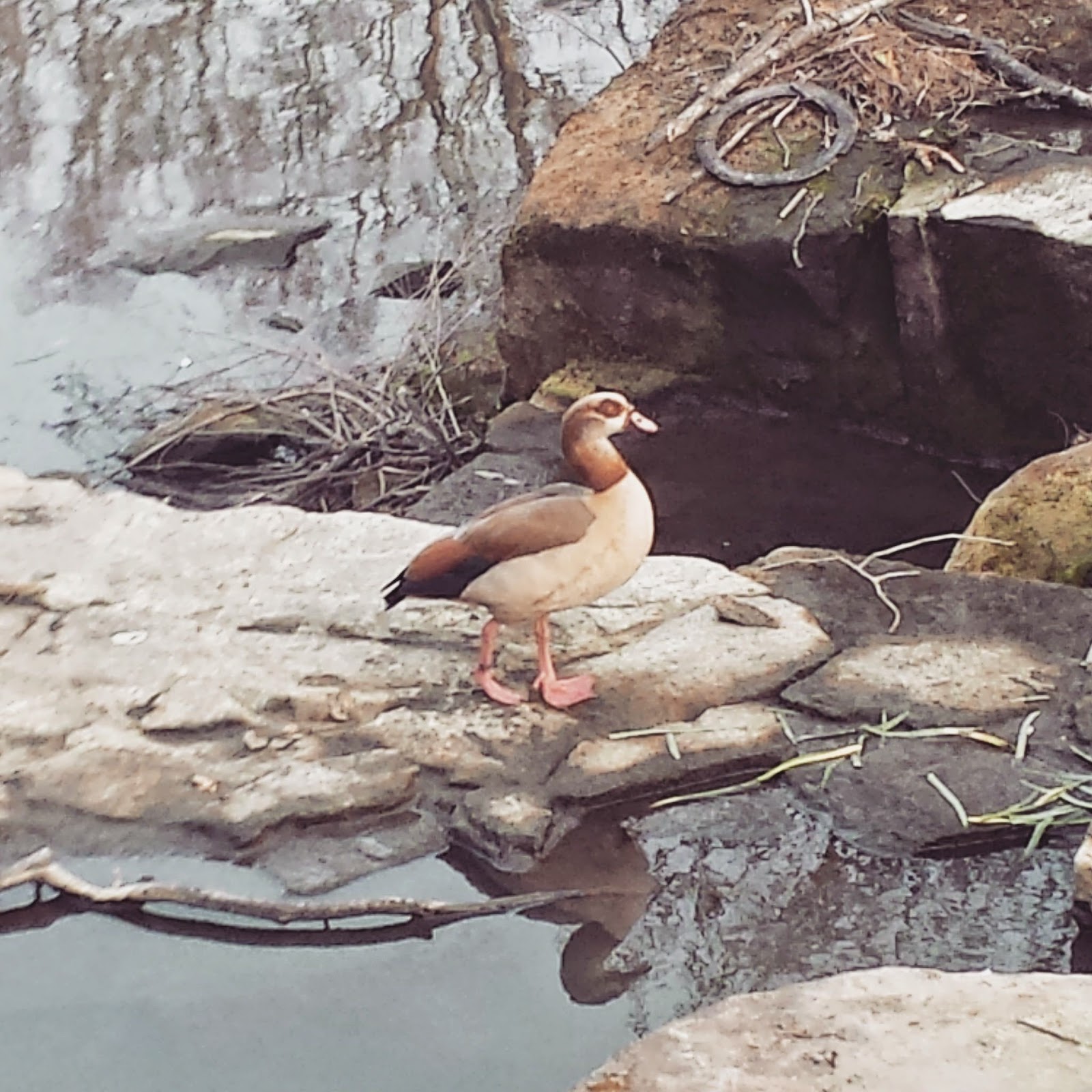
With the arrival of Spring I have seen a couple of things that I thought worthy of a special mention. First off is Mr and Mrs Egyptian Goose (Alopochen aegyptiacus). When I first saw this pair I incorrectly identified them as Shelducks.
Egyptian Goose (beautiful until he opens his mouth)
According to the RSPB there are approximately 1000 of these in the UK. They are very striking and stand out from the Canada Geese that are more abundant in Crystal Palace. They are native to Africa and are thought to have been introduced as ornamental species in the 1700s. The most established population is in Norfolk but their range is spreading. They are a resident species. I don't know where these two have come from or if there are any more in London. As I have said they are very beautiful birds but have one of the least appealing calls of any goose I have heard!

About a month ago Inna and I were walking through the park and came across a gaggle of people staring at something in the pond. We took a look and saw a pair of Coots (Fulica atra) feeding their chicks. This pair had built their nest in the open water, as coots will do, and the female was sat on the nest with the chicks. They were only very tiny and lacked mobility. Dad was busy patrolling the pond gathering food and returning to feed the chicks, this only happens for the first 4-5 days of their lives. I checked in on them for the next couple of days and Dad was still tirelessly working the pond.

Coots lay 5-7 eggs in a go and incubation takes about 21 days. Pairs can have several clutches in a Summer so I'll be keeping my eyes peeled for more. I was running home last night and thought I would see how they are getting on. Both chicks were still alive and had grown considerably. They were both swimming around with the parents and feeding themselves. They hadn't quite got the hang of dipping yet and couldn't stay under for very long at all. London is crammed with wildlife, you just have to keep your eyes peeled and appreciate what is there.

Coot chick with Dad